Today’s fast-paced life, long working hours, and increasingly sedentary lifestyles directly affect our legs, which carry the entire load of our body. That heavy, leaden feeling in your legs when you return home in the evening, aches, swelling in the ankles, or severe cramps that wake you up from a deep sleep at night are often dismissed as simple fatigue. However, these complaints are some of the most important warning signs of varicose vein disease, which occurs when the valves inside the veins in our legs fail.
Many patients avoid getting treatment despite experiencing this painful and exhausting process in their legs. The biggest reason for this is the fear caused by painful, stitched “open vein surgeries” of the past that required weeks of hospital stay. However, modern medicine and medical technology have completely consigned these fears to history with groundbreaking innovations in vascular surgery.
If you want to regain your health without interrupting your work, without general anesthesia, and without surgical cuts or stitches, Radiofrequency Varicose Vein Treatment—one of the most comfortable options for non-surgical varicose vein treatment—is the ideal method for you. In this comprehensive guide, we answer the most frequently searched questions on search engines, such as “How do they close my vein from the inside?”, “How long does the procedure take?”, and “What is the recovery process like?”, in a transparent way and free of heavy medical jargon.
What is Radiofrequency Varicose Vein Treatment and How Does It Work?
Radiofrequency (RF) varicose vein treatment is a non-surgical procedure where malfunctioning main superficial veins—which cause blood pooling in the legs—are closed from the inside using high-frequency radio waves.
The most fundamental difference that sets this method apart from traditional surgeries is its exceptional respect for tissue. While traditional methods involve stripping the diseased vein out of the body through the muscles, the radiofrequency method leaves the vein in place. A very thin, flexible catheter (medical wire) is inserted into the problematic vein. Controlled radio waves emitted from the tip of this wire create a natural thermal energy in the vein wall. This heat shrinks the collagen fibers in the structure of the vein, causing it to collapse and seal shut on its own. This closed and deactivated vein is naturally absorbed and eliminated by the body over time. The blood instantly redirects to other healthy veins in the surroundings, immediately neutralizing the pressure and pain in the legs.
How is Radiofrequency Varicose Vein Treatment Performed? (Step-by-Step Process)
The most comforting moment for our patients visiting our clinic is learning that the procedure is actually as practical as a “lunch break aesthetic.” The process is designed with patient comfort at the center and progresses as follows:
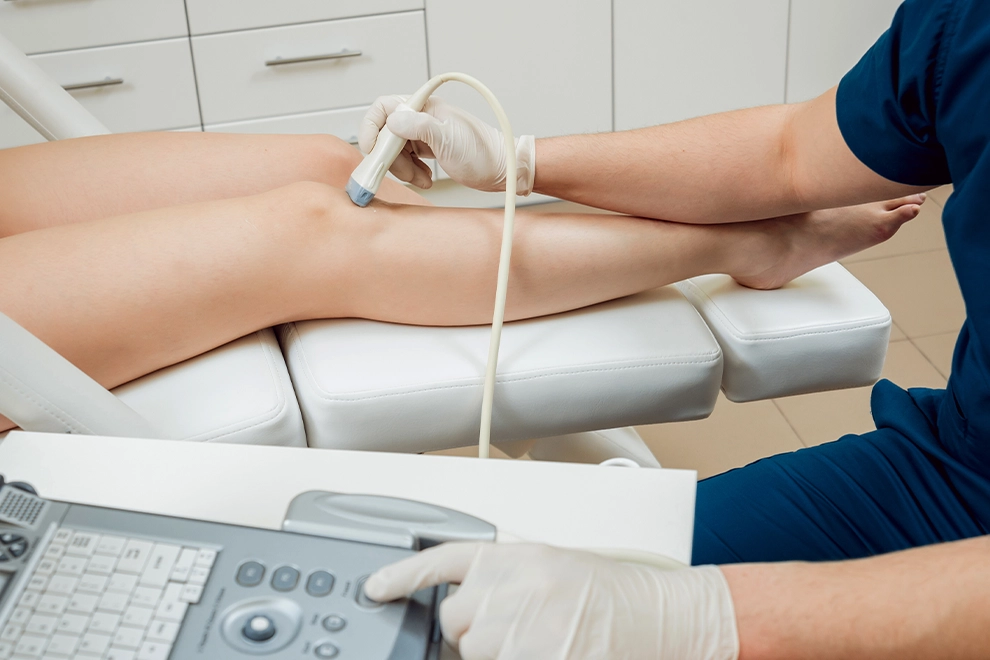
- Mapping with Color Doppler Ultrasound: First of all, a vascular map of your leg is created. It is precisely determined which vein has reflux and where the radiofrequency catheter will enter.
- Comfort with Local Anesthesia: You do not need general anesthesia (narcotics) for the procedure. Only the tiny needle entry point for the catheter and the area surrounding the vein are numbed with local anesthetic medications. Thanks to this, you do not feel any pain or discomfort during the procedure.
- Sealing of the Vein: Monitored live on the ultrasound screen, the thin wire is inserted into the vein, and the vein is shrunk and closed using radio waves.
- Immediate Discharge: Following this 30 to 45-minute procedure, a bandage is wrapped around your leg and your compression stocking is put on. You step off the examination table on your own feet and leave our clinic walking.
What Are the Advantages of Radiofrequency Treatment Over Traditional Surgery?
- No Anesthesia or Incisions: Because the procedure is performed through just a single needle puncture, no stitches are required. Naturally, no surgical or scar marks remain on your leg.
- No Hospital Stay Required: It is a daily outpatient procedure. You receive your treatment, have your coffee, and return home the same day.
- Fast Recovery and Return to Work: Because tissues are not traumatized, post-procedure pain or bruising is minimal. Our patients can generally return to desk jobs or light-paced work the very next day.
- High Success Rate: Accepted as the “gold standard” in international medical guidelines, the permanent success rate of this method is over 95%.
Recovery Process After Radiofrequency Varicose Vein Treatment
The success of the treatment depends not only on the procedure itself, but also on how the patient treats their body afterward. Here are some golden rules you should follow to help your body rapidly adapt to the new circulatory system:
- Walk Frequently: The mindset of “I had a procedure, I must rest in bed” is completely wrong with this treatment. Taking plenty of walks on the day of the procedure and in the following weeks activates your calf muscles, allowing blood to be pumped back to the heart much faster through healthy veins.
- Do Not Neglect Your Compression Stockings: Regularly wearing the medical compression stockings determined by your physician according to your leg measurements during the daytime for the recommended period (usually 2 to 3 weeks) accelerates the recovery process and prevents edema formation.
- Stay Away from Hot Environments: During the first few weeks of recovery, you should avoid activities with vein-dilating effects such as Turkish baths (hammam), saunas, thermal springs, or very hot baths. Warm showers and rinsing your legs with cold water at the end of the shower provide wonderful relief to your circulation.
- Increase Water Intake: Make sure to drink at least 2.5 to 3 liters of water a day to keep blood fluidity at an ideal level and accelerate cellular healing.
Frequently Asked Questions (FAQ)
We answer the questions most frequently searched and worried about by people struggling with varicose vein disease:
1. Is radiofrequency varicose vein treatment a painful or distressing procedure?
No, it is definitely not a painful procedure. The point where the catheter enters the vein and the area around the vein are completely numbed with special local anesthetic (tumescent anesthesia) fluids. The patient is awake throughout the procedure and can converse, but does not feel the intervention in their leg as pain or suffering.
2. Do varicose veins return after radiofrequency treatment?
Since the main superficial vein closed by radiofrequency is absorbed and eliminated by the body, that specific vein cannot reopen or develop varicose veins again. The treatment is permanent. However, because your genetic predisposition continues, new enlargements may develop in other veins over the years due to reasons such as excessive weight gain or prolonged inactivity. This is not a recurrence of the old disease, but rather a new vein becoming diseased.
3. Will there be scars, blemishes, or bruising on my legs after the procedure?
Since the procedure is performed without surgery and without incisions, no suture scars (skars) remain. Only a tiny dot the size of a pimple forms at the catheter entry point, which disappears shortly. Very mild bruising (ecchymosis) on the leg after the procedure is normal, and this condition usually disappears completely on its own within 1 to 2 weeks.
4. Are spider veins (web-like appearance) treated with radiofrequency?
The Radiofrequency Ablation method, performed by entering the vein with a needle, is intended for “thick main veins” beneath the skin. For fine capillary veins on the skin surface, methods such as “Foam Sclerotherapy” or surface “Laser/Radiofrequency” systems are generally preferred. All these procedures are complementary combined treatments.
Kartal Varicose Vein Specialist: Healthy Steps with Op. Dr. Nebiye Tüfekci
The circulatory system is one of the most flawless and finely calculated networks of human anatomy. Every medical intervention to be made in this delicate system requires deep anatomical knowledge, top-tier Color Doppler ultrasound experience, and an aesthetic microsurgical vision. Not only treating the disease, but also elevating the patient’s quality of life and comfort to the highest level is a physician’s most fundamental responsibility.
Blending her profound expertise in cardiovascular surgery throughout her professional career with the most up-to-date non-surgical treatment protocols offered by medical technology, Cardiovascular Surgeon Op. Dr. Nebiye Tüfekci offers the most reliable, painless, and permanent solutions transparently to her patients suffering from persistent leg pain and varicose vein problems. Our goal is to relieve you from that heavy, leaden feeling in your legs without interrupting your professional and social life, leading you to brand-new, light, and free steps.
We perform all diagnostic processes (Color Doppler Ultrasound mapping) and all non-surgical varicose vein treatment applications—such as Radiofrequency, Laser (EVLA), and Foam (Sclerotherapy)—at our modern clinic located inside Bumerang Kartal Residence, where high standards of hygiene and comfort are provided. Located in one of the most convenient and prestigious transportation hubs on Istanbul’s Asian Side, our clinic offers a peaceful transportation experience without traffic congestion for our guests coming from neighboring districts such as Maltepe, Pendik, Tuzla, and Ataşehir, primarily the Kartal region, thanks to its connections to the E-5 highway, metro stations, and coastal road.
To stop postponing the fatigue and pain signals your body gives you, to leave behind the fear of traditional surgery, and to meet comfortable medical solutions, you can contact our clinic at Bumerang Kartal Residence to schedule your preliminary consultation appointment. We are by your side with experienced hands on the days when you will rediscover the lightness of your own steps.